Platinum Air Care Publishes 2026 Ontario Indoor Air Quality Report
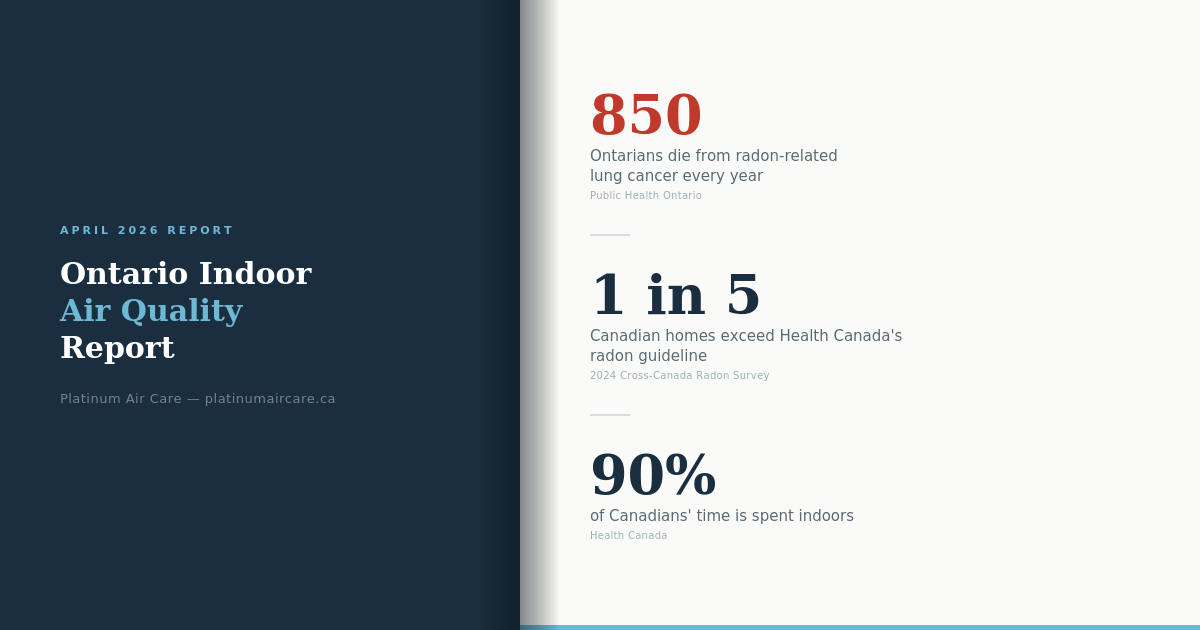
April 2026 — London, Ontario
Platinum Air Care, a family-owned indoor air and water quality company serving over 30,000 homeowners across Southwestern Ontario since 1999, today published its 2026 Ontario Indoor Air Quality Report. The report compiles data from Health Canada, Environment and Climate Change Canada, Statistics Canada, and peer-reviewed research to give Ontario homeowners a clear, independent picture of the air quality risks in their homes — from radon and wildfire smoke infiltration to ventilation gaps in the existing housing stock. The full report is presented below.
2026 Ontario Indoor Air Quality Report
Published by Platinum Air Care | platinumaircare.ca
Serving Southwestern Ontario since 1999
Executive Summary
Most Ontario homeowners have never tested their indoor air, and few have a clear sense of what they're breathing. This report compiles the latest available data from Health Canada, Environment and Climate Change Canada, Public Health Ontario, and peer-reviewed research to change that.
Five headline findings:
- Canadians spend approximately 90% of their time indoors, yet fewer than half of Ontario homeowners have taken any steps to assess or improve their indoor air quality (Health Canada; Statistics Canada, Households and the Environment Survey, 2023).
- Environment and Climate Change Canada issued approximately 5,000 air quality alerts in 2023 — nearly four times the annual average of 1,300 from 2017–2022 — driven almost entirely by wildfire smoke (Jain et al., 2024, Nature Communications).
- During the June 2023 wildfire smoke episodes, daily average PM2.5 concentrations across Ontario surged from 7.4 μg/m³ to as high as 65.3 μg/m³. Asthma-related emergency department visits rose measurably during these episodes (Chen et al., 2025, CMAJ).
- Approximately 1 in 5 Canadian homes (17.8%) have radon levels at or above Health Canada's guideline of 200 Bq/m³, with Ontario-specific data showing 13 of 36 health regions had more than 10% of homes exceeding the guideline — and radon accounts for an estimated 850 lung cancer deaths in Ontario each year (2024 Cross-Canada Survey of Radon; Health Canada; Public Health Ontario).
- As of January 1, 2025, Ontario's updated Building Code mandates HRV or ERV mechanical ventilation in every new home. Modern, energy-efficient construction creates airtight envelopes that cannot ventilate themselves; the code now requires mechanical fresh-air systems to compensate (Ontario Building Code 2024, Section 9.32).
Key Statistics
| # | Statistic | Value | Source | Year |
|---|---|---|---|---|
| 1 | Time Canadians spend indoors | ~90% | Health Canada | 2022 |
| 2 | Ontario households heating with natural gas | 67% | Statistics Canada, CANSIM 153-0161 | 2013 |
| 3 | Ontario residential natural gas customers | 3.8 million | Ontario Ministry of Energy | 2024 |
| 4 | Ontario homes using forced air furnace | 75% | Statistics Canada, HES | 2021 |
| 5 | Canadian homes with radon ≥ 200 Bq/m³ | 17.8% (~1 in 5) | 2024 Cross-Canada Radon Survey | 2024 |
| 6 | Ontario health regions with >10% of homes above radon guideline | 13 of 36 | Health Canada Cross-Canada Survey | 2012 |
| 7 | Radon-attributable lung cancer deaths in Ontario (annual) | ~850 | Public Health Ontario | — |
| 8 | Radon-attributable lung cancer deaths in Canada (annual) | ~3,200 (16% of lung cancer deaths) | Health Canada | — |
| 9 | ECCC air quality alerts issued in 2023 | ~5,000 (vs. ~1,300 avg 2017–2022) | Jain et al., Nature Communications | 2024 |
| 10 | Ontario PM2.5 during June 2023 smoke episodes | Up to 65.3 μg/m³ (baseline: 7.4 μg/m³) | Chen et al., CMAJ | 2025 |
| 11 | Area burned in Canada's 2023 wildfire season | ~15 million hectares (7× avg) | Nature Communications; NRCan | 2024 |
| 12 | Canadian households that have heard of radon | 58% | Statistics Canada, HES | 2023 |
| 13 | Ontario homeowners who have tested for radon | ~10% | Statistics Canada, HES | 2023 |
| 14 | Ontarians living with diagnosed asthma | ~1 in 8 (~1.9 million projected) | To et al., BMC Public Health | 2013 |
| 15 | Ontario Building Code HRV/ERV mandate for new homes | Effective January 1, 2025 | OBC 2024, Section 9.32 | 2025 |
Why Indoor Air Quality Matters in Ontario
Canadians spend approximately 90% of their time indoors — at home, at work, in vehicles, and in public buildings (Health Canada, 2022). That figure is even higher during Ontario's heating season, which spans roughly seven months from October through April across most of the province and is longer still in northern communities.
Ontario's housing stock is shaped by climate. Cold winters drive the design of tight building envelopes intended to retain heat, and the province's prevalence of full basements — standard in the majority of single-family homes — creates ground-contact living spaces where soil gases, including radon, can accumulate. Approximately 67% of Ontario households heat with natural gas, and 75% use forced-air furnace systems (Statistics Canada, CANSIM 153-0161; Statistics Canada, Households and the Environment Survey, 2021). These combustion-based systems can introduce nitrogen dioxide and other byproducts into the home when improperly maintained or inadequately vented.
Put those factors together — sealed homes, long heating seasons, gas appliances, below-grade living spaces — and indoor pollutant concentrations in Ontario homes can substantially exceed outdoor levels. Health Canada and the U.S. Environmental Protection Agency have both noted that indoor air can be two to five times more polluted than outdoor air, even in industrialized urban areas. That figure comes primarily from U.S. EPA research but is widely cited by Canadian public health authorities (Health Canada, 2022; U.S. EPA).
Ontario's approximately 3.8 million residential natural gas customers (Ontario Ministry of Energy, 2024) have an added concern: any gas-fired furnace, water heater, stove, or fireplace is a potential source of combustion byproducts, including carbon monoxide, nitrogen dioxide, and fine particulate matter. Proper venting, regular maintenance, and adequate combustion air supply are the basic safeguards.
Outdoor Air Pollution Trends Affecting Ontario Homes
The 2023 Record Wildfire Season
Canada's 2023 wildfire season was unprecedented. Approximately 15 million hectares burned nationally — more than seven times the historical annual average of roughly 2.5 million hectares and more than double the previous record of 6.7 million hectares set in 1989 (Jain et al., 2024, Nature Communications; Natural Resources Canada, 2024). The Canadian Interagency Forest Fire Centre (CIFFC) recorded over 6,600 fires across the country, with Quebec alone accounting for more than 5 million hectares of the total burned area.
The smoke impacts were continental in scale. Environment and Climate Change Canada issued approximately 5,000 air quality alerts during 2023, compared to a national annual average of roughly 1,300 between 2017 and 2022 (Jain et al., 2024). Some of the worst-affected areas of Canada experienced more than 60 days of poor air quality from wildfire-related pollution. In North America and Europe, an estimated 354 million people experienced at least one day where PM2.5 concentrations exceeded healthy levels, with Canadians experiencing an average of 27 such days (2023 Canadian wildfires research; Nature, 2025).
Direct Impact on Ontario
Southern Ontario was significantly affected during two major smoke episodes in June 2023. A peer-reviewed study published in the Canadian Medical Association Journal found that population-weighted daily mean PM2.5 concentrations across Ontario surged from a pre-smoke baseline of 7.4 μg/m³ (April–May average) to 53.2 μg/m³ during the first episode and 65.3 μg/m³ during the second (Chen et al., 2025, CMAJ). For context, the World Health Organization's 24-hour PM2.5 guideline is 15 μg/m³.
A 2025 study published in Nature attributed the 2023 Canadian wildfires to an increase of 3.82 μg/m³ in Canada's annual mean PM2.5 exposure. To put that in context, Canada had spent decades steadily reducing ambient particulate matter through emissions regulations, and the 2023 fires wiped out much of that progress in a single season. The study estimated that the fires caused between 3,400 and 7,400 acute deaths in North America and between 37,800 and 90,900 chronic deaths in North America and Europe combined from PM2.5 exposure.
2024 and 2025 Trends
While 2024 saw reduced wildfire activity compared to the record 2023 season, experts from the Canadian Forest Service have noted that the underlying conditions — warming temperatures, earlier snowmelt, and more frequent drought — are structural trends rather than anomalies (Natural Resources Canada, 2024). Preliminary data from the 2025 fire season indicates an early start, with PM2.5 concentrations exceeding 150 μg/m³ in several Canadian regions during active smoke transport events.
Why Outdoor Smoke Is an Indoor Air Problem
Wildfire smoke does not stay outside. Fine particulate matter infiltrates homes through gaps in the building envelope, through open windows and doors, and through mechanical ventilation systems that draw in outdoor air. During smoke events, homes without adequate filtration can see indoor PM2.5 levels approach 50–80% of outdoor concentrations. In practical terms, a family's smoke exposure during a multi-day event depends on three things: their furnace filter rating, whether their HRV/ERV system is set to recirculate rather than draw outdoor air, and whether they have portable HEPA air purifiers available.
Indoor Pollutants of Concern in Ontario Homes
Radon
Radon is a naturally occurring radioactive gas produced by the decay of uranium in soil and rock. It is colourless, odourless, and the leading cause of lung cancer in non-smokers. Health Canada estimates that radon accounts for 16% of lung cancer deaths in Canada — approximately 3,200 deaths annually nationwide (Health Canada; Statistics Canada, Environment Fact Sheets, 2016). Public Health Ontario estimates that radon is responsible for approximately 850 lung cancer deaths in Ontario each year.
The 2024 Cross-Canada Survey of Radon Exposure in the Residential Buildings of Urban and Rural Communities — covering more than 70,000 homes — found that approximately 1 in 5 Canadian homes (17.8%) have radon levels at or above Health Canada's guideline of 200 Bq/m³. The earlier 2012 Health Canada survey had estimated a national rate of 6.9%, so the updated figure is more than double.
Ontario's population-weighted estimate from the original Health Canada survey was 4.6% of homes exceeding the guideline, with a raw sample rate of 8%. However, this provincial average masks substantial regional variation: 13 of 36 Ontario health regions had more than 10% of homes testing above the guideline (Health Canada, Cross-Canada Survey of Radon Concentrations in Homes, 2012). The 2024 survey's national findings suggest that Ontario's actual rates may be higher than the earlier provincial estimate indicated, though updated Ontario-specific breakdowns from the 2024 data have not yet been published.
Despite these risks, awareness remains low. Statistics Canada's Households and the Environment Survey (2023) found that only 58% of Canadian households had heard of radon. Among Ontario homeowners not living in apartments, only 10% had tested their home. Health Canada recommends that every home be tested using a long-term detector (minimum 3 months during the heating season), and that homes exceeding 200 Bq/m³ be mitigated — a process that typically involves installing a sub-slab depressurization system.
Ontario's 2024 Building Code strengthened radon provisions by requiring rough-in infrastructure for future radon extraction equipment in new construction. If elevated levels are discovered after occupancy, the rough-in makes mitigation simpler and less expensive.
Volatile Organic Compounds (VOCs)
Volatile organic compounds are emitted as gases from a wide range of building materials, furnishings, cleaning products, paints, adhesives, and personal care products. Common indoor VOCs include formaldehyde (from engineered wood products, insulation, and some textiles), benzene, toluene, and xylene. Health Canada has published Residential Indoor Air Quality Guidelines with recommended exposure limits for several VOCs, including formaldehyde (maximum long-term exposure of 50 μg/m³) (Health Canada, Residential Indoor Air Quality Guidelines).
Health Canada is currently conducting an indoor air quality study in newly constructed homes to investigate pollutant emissions from building products. The concern is straightforward: modern building materials and tighter envelopes may be changing what people are breathing indoors (Health Canada, 2022). Results from a pilot study in two newly constructed homes have been published, with a broader study currently recruiting participants.
In Ontario, where new construction activity has been high, this matters. Tight building envelopes (driven by energy code requirements) trap VOCs from new materials inside the home. Without controlled mechanical ventilation from an HRV or ERV, those compounds accumulate to concentrations well above outdoor ambient levels.
Mould and Humidity
Ontario's climate, basement prevalence, and heating patterns create conditions favourable to mould growth. Health Canada recommends maintaining indoor relative humidity between 30% and 50% — low enough to discourage mould and dust mites, but high enough for respiratory comfort (Health Canada, Residential Indoor Air Quality Guidelines).
Basements are particularly vulnerable. Below-grade construction is in direct contact with soil moisture, and seasonal humidity fluctuations in Southwestern Ontario — where summer humidity regularly exceeds 70% outdoors — can drive basement relative humidity well above the recommended range without active dehumidification. The Lung Health Foundation (formerly Ontario Lung Association) identifies mould as one of the most common indoor air quality problems and notes that living in damp or mouldy housing increases the risk of developing asthma by approximately 40% (Lung Health Foundation; CMHC).
Combustion Byproducts
With 67% of Ontario households heating with natural gas and 3.8 million residential gas customers across the province (Statistics Canada; Ontario Ministry of Energy, 2024), combustion byproducts are a widespread indoor air quality consideration. Gas furnaces, water heaters, gas stoves, and gas fireplaces can all produce nitrogen dioxide (NO₂), carbon monoxide (CO), and fine particulate matter when operating.
Properly maintained and vented gas appliances generally pose minimal risk. However, cracked heat exchangers, blocked flue pipes, backdrafting, and the use of unvented gas appliances (such as some decorative gas fireplaces or supplemental heaters) can elevate indoor pollutant levels significantly. Annual professional inspection of gas-fired heating equipment is recommended by both Health Canada and the Technical Standards and Safety Authority (TSSA), Ontario's regulatory authority for fuel-burning equipment.
Gas cooking stoves have received increased scrutiny in recent years. Research published in peer-reviewed journals has associated gas stove use with elevated indoor NO₂ concentrations and a modestly increased risk of childhood asthma, though the evidence base is still evolving and some findings are debated (Gruenwald et al., 2023, International Journal of Environmental Research and Public Health).
Particulate Matter Infiltration During Wildfire Events
As detailed in the outdoor air section above, wildfire smoke is increasingly an indoor air quality problem. During the June 2023 smoke episodes, Ontario homes without effective filtration were exposed to PM2.5 concentrations far exceeding normal indoor levels. Health Canada's guidance for wildfire smoke events recommends creating a "cleaner air space" within the home by closing windows and doors, running HVAC systems with high-efficiency filters (MERV 13 or higher), and using portable HEPA air purifiers in occupied rooms (Health Canada, Cleaner Air Spaces Guidance for Wildfire Smoke Events).
The effectiveness of these measures depends heavily on the home's building envelope, the existing HVAC system's filter compatibility, and whether the household has portable air purifiers on hand before a smoke event begins. Homes with older, leakier envelopes may see less benefit from simply closing windows, while homes with HVAC systems designed for low-MERV filters may not accommodate higher-rated filters without restricting airflow.
Health and Economic Impact
Asthma in Ontario
Asthma is the most common chronic respiratory disease in Ontario. Research using the Ontario Asthma Surveillance Information System (OASIS) projected that approximately 1 in 8 Ontarians — roughly 1.9 million people — would be living with diagnosed asthma by 2022, continuing a trend of increasing cumulative prevalence even as new-diagnosis incidence rates have stabilized (To et al., 2013, BMC Public Health; Gershon et al., 2010, American Journal of Respiratory and Critical Care Medicine). Nationally, approximately 3.8 million Canadians were living with diagnosed asthma as of 2011/12, with the number continuing to grow (Public Health Agency of Canada, CCDSS, 2018).
Most asthma triggers are indoor air problems. The Lung Health Foundation lists mould, dust mites, pet dander, tobacco smoke, VOCs, and combustion byproducts as common triggers — all of which can be reduced through better ventilation, filtration, humidity control, and source removal.
Wildfire Smoke and Acute Health Effects
The peer-reviewed study of Ontario's June 2023 smoke episodes found statistically significant increases in emergency department visits for asthma-related causes during days classified as heavy smoke days (Chen et al., 2025, CMAJ). The study covered all 34 Ontario public health units and used data from the Ontario Ministry of the Environment, Conservation and Parks' air quality monitoring network alongside satellite-based smoke plume data.
Economic Costs
Wildfire smoke has a dollar cost. A widely cited estimate from Canadian researchers found that the five-year health-related economic impact of wildfire-attributable PM2.5 in Canada (covering 2013–2015 and 2017–2018) was approximately $49 billion CAD. That figure includes premature deaths, hospitalizations, emergency visits, and lost productivity (Matz et al., 2020, cited in Flood et al., 2025, Journal of Geophysical Research: Atmospheres).
Radon adds to that toll. With an estimated 3,200 radon-related lung cancer deaths annually in Canada — including approximately 850 in Ontario — the healthcare costs are real, though comprehensive Ontario-specific economic estimates have not been published by Tier 1 sources.
What Ontario Homeowners Can Do
Ventilation: HRV and ERV Systems
As of January 1, 2025, Ontario's updated Building Code (OBC 2024, Section 9.32) mandates that every new home include a heat recovery ventilator (HRV) or energy recovery ventilator (ERV) as part of its mechanical ventilation system. This builds on an earlier 2017 mandate. The reason is simple: modern, energy-efficient homes are too airtight to rely on incidental air leakage for fresh air.
For the roughly 5.6 million existing Ontario households (Natural Resources Canada, SHEU, 2019), the vast majority of homes built before 2017 do not have HRV/ERV systems. Retrofitting an HRV into an existing forced-air system is possible and provides year-round fresh air exchange while recovering heat from exhaust air — typically at 60–80% efficiency. Health Canada and CMHC both recommend mechanical ventilation as a primary strategy for maintaining indoor air quality, particularly in homes that have been weatherized or air-sealed (CMHC, HRV and ERV Guide).
Filtration
During normal conditions, furnace filters rated MERV 8–11 are adequate for most residential systems. During wildfire smoke events, Health Canada recommends upgrading to MERV 13 or higher where the HVAC system can accommodate the increased static pressure. Portable HEPA air purifiers (which capture 99.97% of particles at 0.3 microns) are recommended for creating cleaner air spaces in bedrooms and main living areas during smoke events (Health Canada, Cleaner Air Spaces Guidance).
Homeowners should verify their HVAC system's filter compatibility before upgrading — installing a filter with too high a MERV rating in a system not designed for it can restrict airflow, reduce efficiency, and potentially damage the blower motor.
Radon Testing
Health Canada recommends that every home in Canada be tested for radon. Testing involves placing a long-term detector (minimum 3 months, ideally during the heating season from October through March) in the lowest regularly occupied level of the home. DIY test kits typically cost $30–$70 and are available from hardware retailers and online suppliers. Certified electronic radon monitors are also available for continuous monitoring.
If results exceed 200 Bq/m³, Health Canada recommends remediation: homes between 200 and 600 Bq/m³ should be fixed within two years, and homes above 600 Bq/m³ within one year. Remediation is typically performed by a Canadian National Radon Proficiency Program (C-NRPP) certified professional and most commonly involves installing a sub-slab depressurization system. Under Ontario's Tarion warranty program, new homes that test above the Health Canada guideline within the warranty period are covered for the cost of a mitigation system installed by a C-NRPP professional.
Source Control and Maintenance
Filtration and ventilation help, but the best approach is keeping pollutants out of the air in the first place. That means annual inspection and maintenance of gas-fired heating equipment, exhaust fans vented to the outdoors in kitchens and bathrooms, dehumidifiers in basements during summer, low-VOC paints and building materials when renovating, and no unvented combustion appliances indoors.
Health Canada and CMHC provide free, publicly available guidance on all of these measures through their respective websites.
Frequently Asked Questions
How bad is the air quality inside Ontario homes?
Indoor air in Ontario homes can contain two to five times the concentration of pollutants found outdoors, according to figures cited by Health Canada and the U.S. EPA. In tightly sealed homes heated with natural gas — which describes the majority of Ontario's housing stock — combustion byproducts, volatile organic compounds, and allergens can accumulate without adequate ventilation. During wildfire smoke events, outdoor PM2.5 infiltrates indoors and can persist for hours after outdoor conditions improve.
Is radon a problem in Southwestern Ontario?
Yes. While Ontario's provincial average for homes exceeding the Health Canada radon guideline (200 Bq/m³) is lower than some Prairie provinces, 13 of 36 Ontario health regions had more than 10% of homes above the guideline in Health Canada's national survey. Radon levels vary house to house based on soil composition, foundation type, and ventilation — the only way to know your level is to test. Health Canada recommends testing every home.
Does wildfire smoke get inside my house?
It does. Fine particulate matter (PM2.5) from wildfire smoke infiltrates homes through gaps in the building envelope, through ventilation air intakes, and through doors and windows. During the June 2023 smoke events, Ontario's average PM2.5 concentrations rose to more than eight times their normal levels. Homes with MERV 13+ furnace filters and sealed building envelopes fare significantly better than those relying on standard MERV 8 filters or natural ventilation.
Do I need an HRV or ERV in my existing Ontario home?
Ontario's Building Code now requires HRV or ERV systems in all new homes as of January 1, 2025. For existing homes, an HRV retrofit is strongly recommended — particularly in homes that have been air-sealed or weatherized, homes with persistent humidity or condensation issues, or homes where occupants experience unexplained respiratory symptoms. Health Canada and CMHC both identify mechanical ventilation as a primary tool for maintaining healthy indoor air.
What is the single most important thing I can do to improve my indoor air quality?
Test for radon. It is the second leading cause of lung cancer in Canada, responsible for an estimated 850 deaths in Ontario each year, and it is entirely fixable. A long-term radon test kit costs $30–$70 and requires no professional installation. If levels are elevated, a certified mitigation professional can reduce concentrations by 80% or more with a sub-slab depressurization system. Beyond radon, ensuring your furnace filter is appropriate for your system (MERV 11–13 where compatible), running exhaust fans during cooking and bathing, and maintaining your heating system annually are high-impact, low-cost steps every Ontario homeowner can take.
Data Gaps: Where Original Research Could Contribute
The following areas represent genuine gaps in the publicly available evidence base. Organizations with access to aggregated in-home testing and inspection data, particularly those with long service histories across Southwestern Ontario, could fill these gaps with original primary data:
- Aggregated radon test results for Southwestern Ontario municipalities (London, Kitchener-Waterloo, Cambridge, Brantford, Chatham-Kent, Sarnia, Windsor). Health Canada's provincial data is based on its 2012 survey; the 2024 national survey has not yet published Ontario sub-regional breakdowns. Local testing data aggregated by municipality would be the most current Ontario-specific radon dataset available.
- Indoor PM2.5 measurements during wildfire smoke events. If in-home air quality readings were recorded during the 2023 or subsequent smoke seasons, this data would directly address the question of how effectively Ontario homes filter wildfire smoke — a question that existing published research has not answered with in-home measurement data.
- Duct contamination levels pre- and post-cleaning. No Ontario-specific published dataset documents what professional duct cleaning removes from residential HVAC systems. Aggregated pre/post measurements (particulate levels, mould counts, allergen concentrations) would fill a gap in the evidence.
- Basement humidity and mould incidence by SW Ontario geography. No Tier 1 source provides a prevalence estimate for mould in Ontario homes. Inspection data documenting humidity levels and visible mould findings across thousands of homes would be a first-of-its-kind Ontario dataset.
- Furnace filter condition and MERV rating at time of service. Data on what homeowners are actually using — filter condition, MERV rating, replacement frequency — would quantify the gap between recommended practice and real-world behaviour.
Methodology and Sources
How This Report Was Compiled
This report was compiled in April 2026 by reviewing and synthesizing data from Canadian federal and provincial government sources, peer-reviewed scientific literature, and public health authority publications. Every numeric claim in this report is traced to a specific primary source identified below. Where Ontario-specific data was unavailable, Canadian national data was used and the substitution is noted explicitly.
No data in this report was drawn from industry whitepapers, commercial blog posts, or HVAC manufacturer publications. News articles were used for context only, not as primary sources for statistics.
Primary Sources Cited
- Health Canada. "Indoor Air Quality." Canada.ca. Last modified August 29, 2022. Link
- Health Canada. "Cross-Canada Survey of Radon Concentrations in Homes — Final Report." 2012. Link
- Evict Radon / Health Canada. "2024 Cross-Canada Survey of Radon Exposure in the Residential Buildings of Urban and Rural Communities." 2024. Link
- Health Canada. "Radon Action Guide for Provinces and Territories." Last modified February 2026. Link
- Statistics Canada. "Radon: The Invisible Threat That Many Canadian Households Aren't Aware Of." September 2, 2025. Link
- Statistics Canada. "The Heat Is On: How Canadians Heat Their Home During the Winter." 2022. Link
- Statistics Canada. "Environment Fact Sheets — Radon Awareness in Canada." Catalogue no. 16-508-X. December 2016. Link
- Ontario Ministry of Energy. "Ontario Energy Snapshot." Last modified January 8, 2026. Link
- Canada Energy Regulator. "What Is in a Canadian Residential Natural Gas Bill?" Link
- Jain, P., et al. "Drivers and Impacts of the Record-Breaking 2023 Wildfire Season in Canada." Nature Communications, 15, Article 6764. August 20, 2024. Link
- Liu, X., et al. "Long-Range PM2.5 Pollution and Health Impacts from the 2023 Canadian Wildfires." Nature, 2025. Link
- Chen, H., et al. "Impact of the 2023 Wildfire Smoke Episodes in Ontario, Canada, on Asthma and Other Health Outcomes: An Interrupted Time-Series Analysis." Canadian Medical Association Journal, 2025. Link
- Flood, S., et al. "The Impact of the 2023 Canadian Forest Fires on Air Quality in Southern Ontario." Journal of Geophysical Research: Atmospheres, 2025. Link
- Natural Resources Canada. "Canada's Record-Breaking Wildfires in 2023: A Fiery Wake-Up Call." Link
- To, T., et al. "Is Asthma a Vanishing Disease? A Study to Forecast the Burden of Asthma in 2022." BMC Public Health, 13:254. March 21, 2013. Link
- Gershon, A.S., et al. "Trends in Asthma Prevalence and Incidence in Ontario, Canada, 1996–2005: A Population Study." American Journal of Respiratory and Critical Care Medicine, 2010. Link
- Public Health Agency of Canada. "Asthma in Canada — Data Blog." Chronic Disease Infobase. Link
- Lung Health Foundation (formerly Ontario Lung Association). "Indoor Air Quality." Link
- Natural Resources Canada. "Survey of Household Energy Use (SHEU) 2019." Link
- York Region Public Health. "Radon: Test Your Home." Last modified October 30, 2025. Link
- CMHC. "HRV and ERV Guide for Multi-Unit Residential Buildings." 2017. Link
- Leech, J.A., et al. "Effects of Age, Season, Gender and Urban-Rural Status on Time-Activity: Canadian Human Activity Pattern Survey 2 (CHAPS 2)." International Journal of Environmental Research and Public Health, 2014. Link
- Ontario Building Code 2024. Section 9.32 — Mechanical Ventilation for Dwelling Units. Effective January 1, 2025.
© 2026 Platinum Air Care. This report may be cited and shared with attribution. Data and claims should be verified against the primary sources listed in the Methodology section.
Media Contact
Angelo Dereza
Platinum Air Care
📍 410 Third Street, London, ON
📞 (519) 686-3595
✉️ media@platinumaircare.ca
🌐 www.platinumaircare.ca