
RPS Central Photo Catalyst UV System
Whole-Home PCO Air Purifier With UV-C for Your Furnace
The RPS Central Photo Catalyst UV System is a whole-home UV-C and PCO air purifier: it treats the odors and VOCs in the air your furnace moves through every room.
Free in-home air test in London and Southwestern Ontario: about 30 minutes, and no obligation.
Odors, VOCs, and the gases off cleaning products are molecules: too small for any filter to strain out. This treats them instead. Two germicidal UV-C lamps activate a photocatalytic coating inside your ductwork, oxidizing what passes through into water vapor and carbon dioxide. No fan, no filter, nothing added to your furnace’s airflow.
- Two 24 W germicidal UV-C lamps and a photocatalytic chamber
- Ozone-free: water vapor and carbon dioxide out
- No fan, no filter media: nothing added to your furnace’s airflow
- 10-year parts warranty, lamps excluded
Odors, VOCs, and filters
Why a Filter Cannot Catch a Smell
Filtration works by size. A filter is a barrier with holes in it, and anything bigger than the holes gets stopped: dust, pollen, dander, smoke particles. That is why a good HEPA does so much for a dusty house. But a smell is not a particle. Cooking odors, pet odors, the fumes off fresh paint, and the VOCs from cleaning products are individual molecules, orders of magnitude smaller than anything a filter can hold. They pass straight through and keep circulating.
So this does not try to catch them. It breaks them apart instead. UV-C light activates a photocatalytic coating inside the chamber, and the reaction at that surface oxidizes what reaches it, leaving water vapor and carbon dioxide rather than a filter that needs emptying. It is the half of the job filtration cannot do, which is why the two are usually fitted together.
Two halves of the job
-
A filter catches
Particles, by size: dust, pollen, dander, and smoke particles.
-
UV-C + PCO treats
Molecules: cooking and pet odors, the fumes off fresh paint, and the VOCs from cleaning products.
A home that wants both ends up with one of each: we often fit this alongside the RPS Whole Home HEPA.
How it works
How Photocatalytic Oxidation (PCO) Cleans the Air
Three steps, in order, as the air passes through the treatment chamber in your ductwork.
-
Step 01
The air is drawn past the reactor
Contaminants riding the return air (bacteria, mold spores, VOCs, the molecules behind cooking and pet odors) pass into the treatment chamber on their way to the furnace. No fan, no filter media, nothing added to the airflow.
-
Step 02
UV-C light super-activates the coating
Two germicidal lamps flood the chamber, and a refraction plate spreads the light so it reaches the photocatalytic coating on every surface rather than only what passes directly in front of a bulb.
-
Step 03
Oxidation breaks the contaminants down
The activated coating oxidizes what reaches it, reducing airborne contaminants to water vapor and carbon dioxide. Nothing is collected, so there is no filter to fill up.
Is it right for your home?
Where the RPS PUV Is the Right Choice
Filtration and UV do different halves of the job. This is the half that deals with what you can smell rather than what you can see.
- Odors are the problem: cooking, pets, smoke, damp
- You already have filtration and want the part filters cannot catch
- VOCs from cleaning products, new furniture, or renovations
- Mold growth on the coil or inside the ductwork
- You want nothing added to your furnace’s airflow
- A clinic, salon, or office where odor control matters
UV-C and PCO options
How It Compares to the Other UV Air Purifier We Fit
Both use UV-C with photocatalytic oxidation, and both are duct-mounted. The difference is what else is in the box.
RPS PUV System
Two double lamps · larger chamber
This page
Two lamp assemblies, each a double tube, which is why you will sometimes see this described as a four-lamp system. More UV output through a bigger treatment chamber. Lamps are replaced yearly.
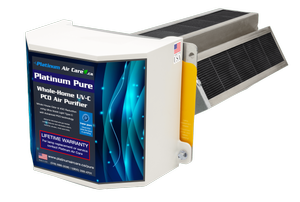
Platinum PURE
Single lamp · tighter install
A single lamp in a smaller body, designed to sit above the A-coil and needing a much smaller opening cut into the ductwork. Lamps run two or three years depending on which is fitted.
Two different jobs
Neither captures a particle. Where dust, pollen, and dander are the concern, a UV system is usually paired with the RPS Whole Home HEPA or the Platinum TrueHEPA. The MedicAir® Pro does both jobs in one portable cabinet. On a furnace, matching the MedicAir® Pro takes two units: this one and the RPS Whole Home HEPA.
-
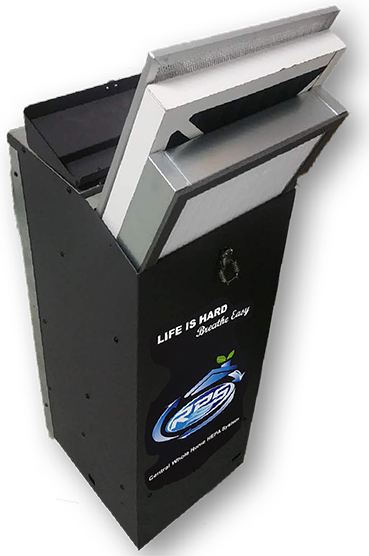 RPS Whole Home HEPA
Bypass HEPA including carbon filtration for the whole house
RPS Whole Home HEPA
Bypass HEPA including carbon filtration for the whole house
-
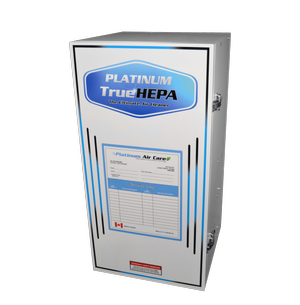 Platinum TrueHEPA
True HEPA filtration treating every room the ducts reach
Platinum TrueHEPA
True HEPA filtration treating every room the ducts reach
-
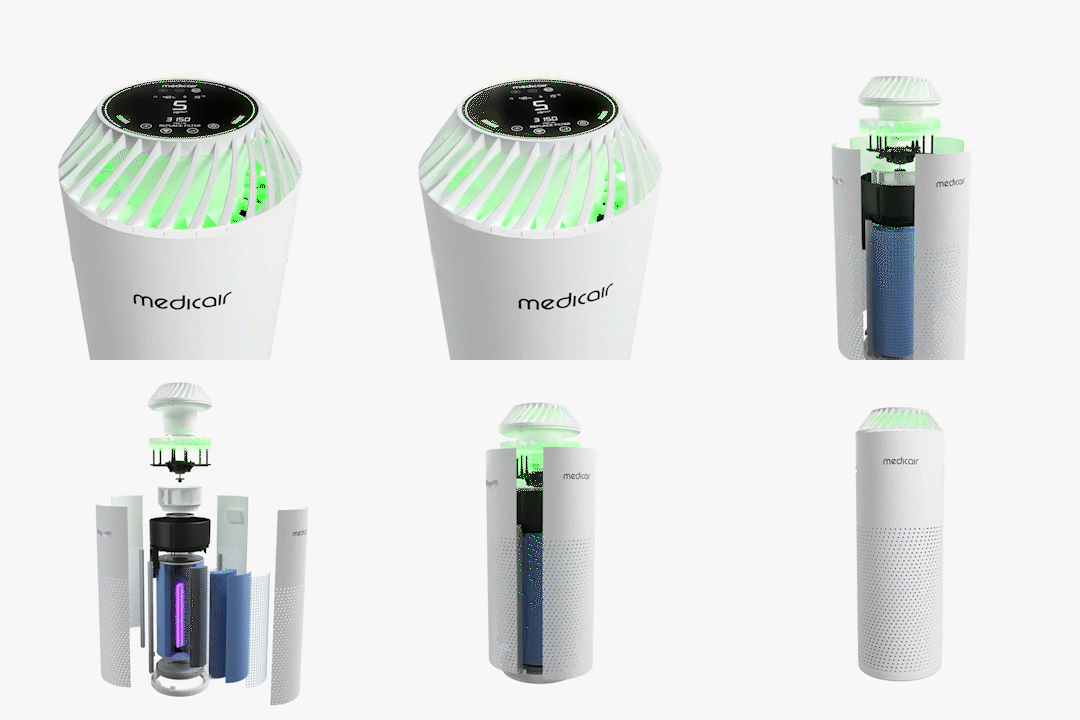 MedicAir® Pro
Both jobs in one portable cabinet
MedicAir® Pro
Both jobs in one portable cabinet
See our UV air purifier systemsCompare all our air purifiers
Specifications
RPS Central Photo Catalyst UV System Specifications
- Model
- PUV48
- Technology
- Germicidal UV-C combined with photocatalytic oxidation (PCO)
- Lamps
- Two UV lamps, 24 W each, 48 W total
- Lamp size
- 31.7 cm × 3.8 cm
- UV output
- 2,400 / 4,800 microwatts
- Reactor
- Photocatalytic coating throughout the chamber, with a refraction plate to spread the light
- Ozone
- None: the system is ozone-free
- By-products
- Contaminants are reduced to water vapor and carbon dioxide
- Mounting plate
- 40.5 cm × 20.0 cm, sitting 22.9 cm proud of the duct
- Space required inside the duct
- 14.5 cm H × 17.0 cm D
- Orientation
- Perpendicular to the airflow so the air passes the lamps first. Return or supply side: supply side can be more effective
- Weight
- 11 lb (5.0 kg) complete
- Electrical
- 120 V, 60 Hz. UL-listed electronic ballast, 9 ft three-prong cord, 125 Vac 2 A fuse
- Effect on the furnace
- None. No fan and no filter media, so nothing is added to the airflow
- Lamp replacement
- Yearly
- Warranty
- 10-year parts excluding the lamps, plus lifetime service, lifetime trade-in, and fire-protection coverage
What our customers say
Platinum Air Care is rated 4.9 from 2,300+ Google reviews across London and Southwestern Ontario, installing and servicing air purifiers since 1999.
Already have one?
Is This the RPS PUV on Your Ductwork?
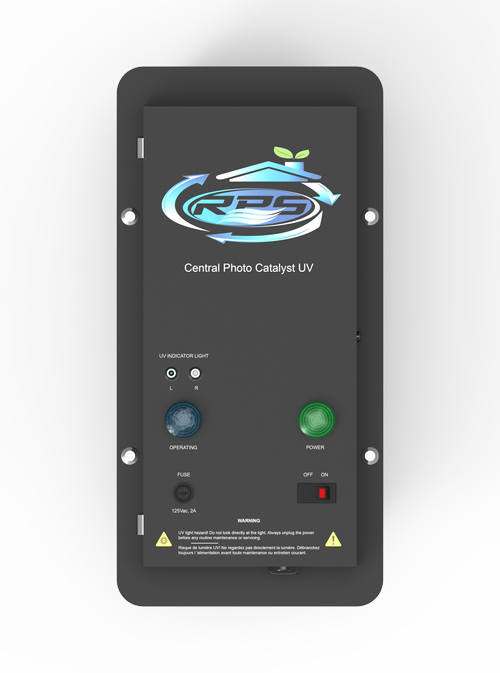
A lot of people inherit one of these with the house and have no idea what it is or who made it. If this matches what is in your basement, you have an RPS Central Photo Catalyst UV System, and we stock lamps for it.
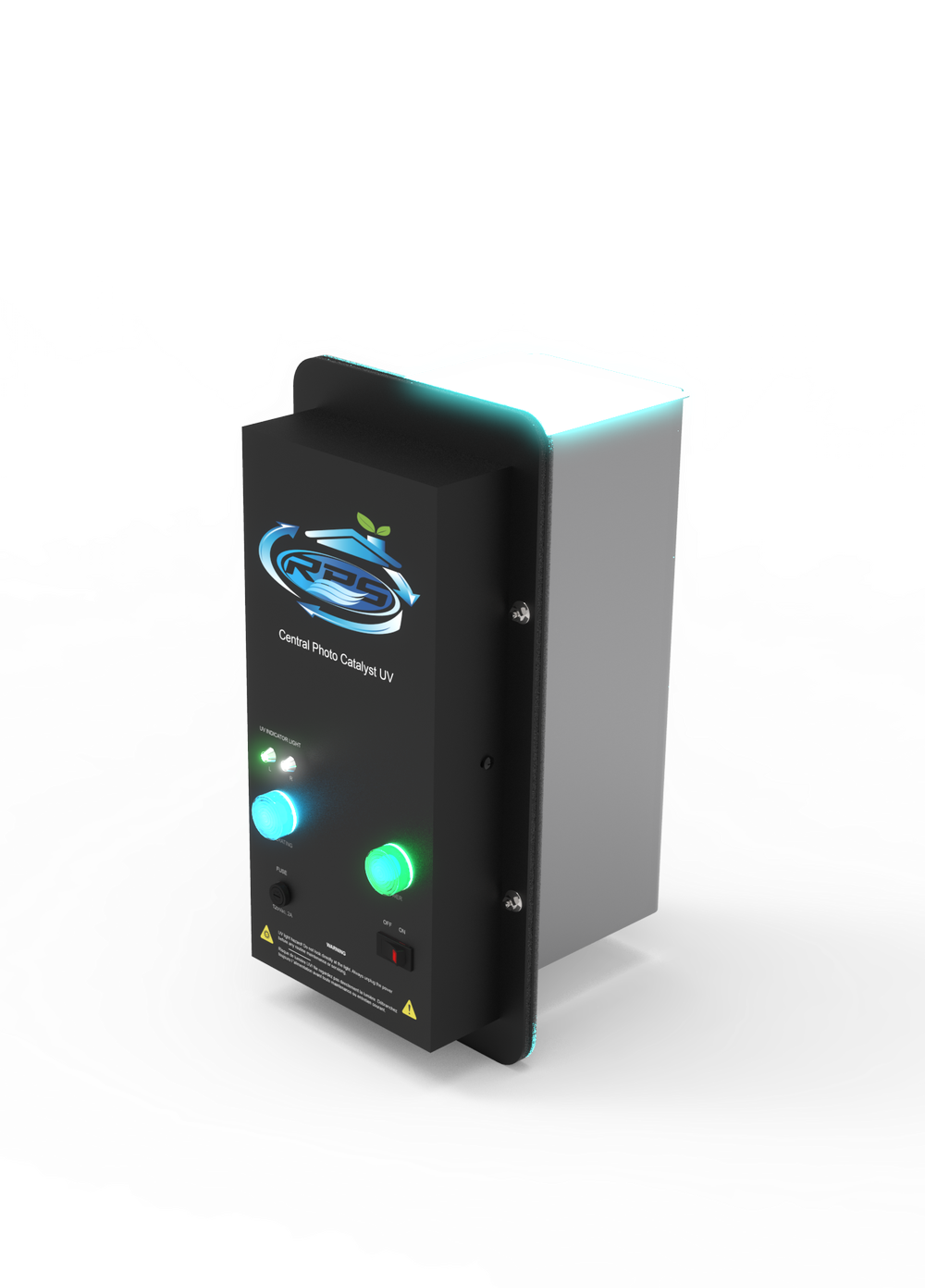
- A slim black control box mounted on the side of the ductwork, not inside it
- An RPS logo with “Central Photo Catalyst UV” printed underneath
- A blue OPERATING light and a green POWER light on the face
- Two small pinholes labeled UV INDICATOR LIGHT (L and R), one per lamp
- A rocker ON/OFF switch and a fuse marked 125Vac, 2A
- A bilingual UV hazard warning across the bottom of the panel
Replacement lamps for the RPS PUV
-
Lamp L
Germicidal UV-C lamp
Replaced yearly. The L pinhole on the panel is lit while it is working: if that pinhole is dark, this is the lamp to change.
-
Lamp R
Germicidal UV-C lamp
Replaced yearly, same as the left. Both pinholes should be lit whenever the POWER light is green.
-
Chamber
Photocatalytic coating
Not a consumable. The coating is activated by the lamps rather than used up, so there is nothing here to replace.
Calling? Have the model handy. We ship lamps and parts anywhere in North America.
Common questions
RPS PUV Air Purifier FAQ
Will this work with my furnace?
It fits any central forced-air system, vertical or horizontal, and installs into the ductwork or the air handler. It has no fan and no filter media, so it adds nothing to the airflow your furnace has to move.
How much does a whole-home PCO air purifier cost?
It depends on the equipment and on the house: a portable and a duct-mounted install are not the same job, and what suits one home is wrong for the next. That is what the free in-home air test is for, and it costs nothing.
Does it replace my HEPA or my furnace filter?
No. Filtration removes what UV cannot, and UV treats what filtration cannot. A home that wants both ends up with one of each, which is why we often fit this alongside the RPS Whole Home HEPA.
How is this different from a filter?
A filter catches particles by size. Odors, VOCs, and the gases that come off cleaning products or new furniture are molecules, far too small to be caught that way. UV-C and PCO treat those instead of trying to strain them out, which is why a HEPA and a UV system do different jobs.
Will it help with smells?
That is the job it was built for. Cooking, pets, smoke, and damp all leave molecules in the air that pass straight through filters, and those are what oxidation breaks down.
Does it produce ozone?
No. The system is ozone-free. What comes out the other side is water vapor and carbon dioxide.
RPS PUV or Platinum PURE: which suits my furnace?
We fit two, and both use UV-C with photocatalytic oxidation. The RPS PUV puts more UV output through a bigger treatment chamber, and its two lamps are replaced yearly. The Platinum PURE is a single lamp in a smaller body, designed to sit above the A-coil, and needs a much smaller opening cut into the ductwork. What suits one home is wrong for the next: that is what the free in-home air test is for, and it costs nothing.
Is the UV light dangerous?
Not in normal use: the lamps are sealed inside the ductwork, and there is nothing to see from outside. The panel carries a warning because the power should always be unplugged before any service work. The indicator pinholes on the panel tell you whether both lamps are lit.
How much maintenance is there?
There is no filter to change. The two UV lamps are the only consumable, and the indicator pinholes on the panel tell you at a glance whether both are still lit. We recommend an annual service visit to check it.
What does it cost to run?
Two 24 W lamps, so under 50 W with the unit running: less than a single old-style light bulb. There is no fan and no motor, which is where most of the draw would otherwise be.
Where do I get replacement lamps for an RPS PUV?
From Platinum Air Care. UV lamps are stocked: tell us the model and we will get the right ones to you, or fit them on a service visit. The two lamps are replaced yearly, and we ship lamps and parts anywhere in North America.
Free in-home air test London and Southwestern Ontario
Not sure whether you need UV, filtration, or both?
Our technicians measure your air on-site and go through the readings with you: about 30 minutes, no cost, and no obligation. Based on the results and your interest, we show you the options best suited for your home.
4.9 from 2,300+ Google reviews100,000+ homes testedSince 1999